
The Secret Lives of Plants
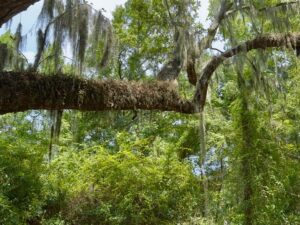
Spanish Moss and dried out Resurrection Fern; Coastal Discovery Museum
by Sharon Lowe
We all know that plants are alive, but have you ever thought that plants have lives, similar to humans and other animals? I’m here to show you that they do. Some plants, like Pitcher Plants and Venus Fly Traps survive by eating insects. Other plants, like the two native plants I am going to discuss, have adaptations that keep them alive even when conditions are not optimal.
Two native Hilton Head Island plants come to mind when I think of plants with lives. One is very abundant on the island; so abundant that we probably don’t pay much attention to it, even though it is very visible. The other is also abundant but is not as showy and is mostly hidden from view – you really must look for it. Both live on trees all over the Island.
You might have guessed the first one – Spanish Moss – but the other is less well known– the Resurrection Fern.
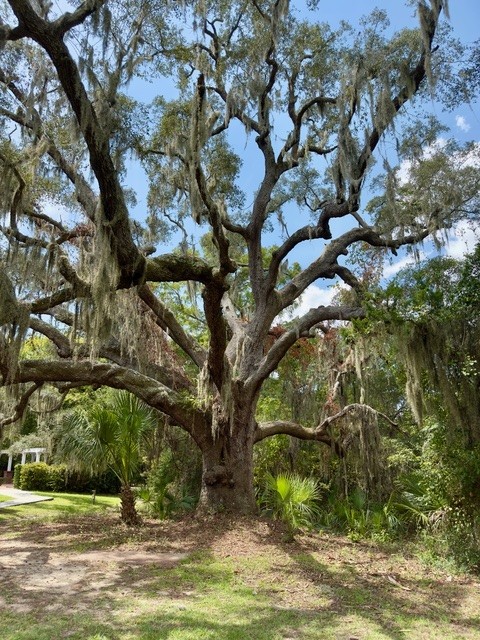
Live Oak with Spanish Moss, Coastal Discovery Museum
Spanish Moss
Spanish Moss (Tillandsia usneoides) hangs on trees and sometimes bushes all over the Island. Its name is very deceiving – it is not Spanish and it is not a moss. It is actually a member of the pineapple family – Bromeliaceae – and drapes its silvery-gray strands from trees. It is a flowering perennial plant that is also related to air plants. It hangs on host trees like the Live Oak and Bald Cypress, which it uses just for physical support. Contrary to some old wife’s tales, it is not a parasite and does not take any nutrients from the tree.
If it isn’t Spanish and not a moss, how did it get its name? Originally, Indigenous people called it by names that meant “tree hair” or “tree beard” (Itla-okla). When French Explorers arrived, the drooping grey strands apparently reminded them of the scruffy, long beards of Spanish conquistadors, so they named it Barbe Espagnol, or “Spanish Beard”. The Spanish fought back with a name meaning “French hair” but the French name stuck and evolved into “Spanish Moss.” (source: NPS Teachers Resources)
So, how does the Spanish Moss live? It doesn’t have roots, which is how most plants get moisture and nutrients. Instead, the scales on its stems and leaves absorb moisture and trap dust and nutrients from the air.
Other than looking pretty and making for some great photographs, what purpose does Spanish Moss serve? Well, if you are an insect or spider, those dense leaves and stems look like a great place to hang out. If you look closely, you might see tiny red bugs (chiggers) or other bugs and spiders. A word of warning – look but don’t touch! Other larger creatures, such as bat or snakes, also find the dense strands to be an attractive hiding spot, especially if they are close to the ground. And birds use it for nesting material. Humans have also used Spanish Moss for some interesting purposes. Until about 1960, manufacturers in the US and Europe used it to stuff automobile seats and furniture! Among other things, Indigenous people used it to make bedding and sometimes clothing, using the inner black core to make thread. (source: Eat the Weeds)
Just like other air plants, Spanish Moss makes a fun and interesting house plant – just make sure you start with moss that has been cleansed of any bugs. You want a light, humid environment and something to put it on or in – no soil necessary. Consider using a piece of wood – maybe some driftwood from the beach – or a hanging open glass container. If the air is dry, like in the winter when the heat is going, use a mister to keep it moist or even give it a good soaking in some fresh water. While it needs light, it does not like direct sunlight so keep it away from those sunny spots. For some more tips and ideas, go to Gardeners World.
The Resurrection Fern
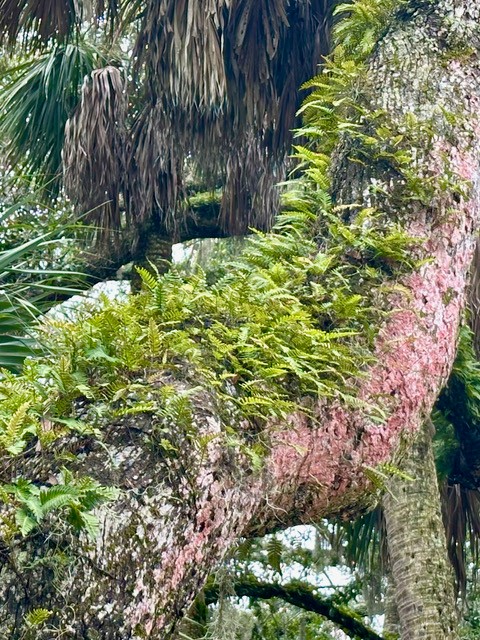
Resurrection Fern after the rain, Palmetto Dunes
The Resurrection Fern (Pleopeltis michauxii is the Southeastern variety) is another native plant that lives on trees all over Hilton Head Island. It just isn’t quite as showy as Spanish Moss so you have to look harder for it. Like Spanish Moss, it is an air plant that grows harmlessly on the bark of trees, primarily oaks and cypress.
Why is it called the Resurrection Fern? While most plants can only lose about 10% of their water content before they die, the Resurrection Fern can lose as much as 97% of its water content during dry periods and still survive! When exposed to water, the fern expands and turns green, coming back to life. Researchers have estimated that a Resurrection Fern could last 100 years without water and still revive after just one exposure to rain. How is that for an amazing feat? (source: Naples Garden)
Like Spanish Moss, the Resurrection Fern serves as shelter for small animals, especially insects and lizards, which in turn attract birds, providing them the food they need. The Aztecs used the ferns as a diuretic and liver healer. (source: Jekyll Island Magazine)
Finally, like Spanish Moss, you can keep it as a houseplant in the right conditions. It works best mounted on cork bark, driftwood, or tree fern fiber wrapped in sphagnum moss. Since we have a natural source of driftwood, that medium would be my choice. It can be potted but is very particular so mounting it is much easier and less ongoing work. It likes a moderately humid environment, light fertilizer, and medium indirect light. Let it dry out some between waterings – use a mister with a mounted plant. Remember, it is okay if it goes brown – a little water will perk it right back up. But, overwatering will cause root rot, which can invite insects and cause the fern to die. (source: Growli Plant Care)
More Resources
If this post has piqued your interest, I hope you will go explore and see where you can find these plants and others native to our Island. Look closely and admire them from afar. After a rainfall, go look for the Resurrection Fern – you will be amazed at how vibrant and alive it looks. You might even find it in your own yard.
I also encourage you to go explore the Coastal Discovery Museum – it is a local treasure and entrance is free! The grounds are beautiful any time of the year and they offer many classes and events. If you want to learn more about our local plants and animals, I encourage you to look at the “Nature Up Close” activity that meets on select Wednesdays. You will “Get an up-close look at the incredible diversity of the natural world in this engaging nature program series. Each program explores a different topic, highlighting the fascinating plants, animals, and habitats of the Lowcountry.”