
Dolphins-Smart, Playful and in our Waters
by PD Owner Sharon Lowe
There are plenty of reasons to come to Hilton Head Island – the beach and golf courses top most lists – but one of my favorite things about the Island is the diversity of the animals who call it home. And one of my favorite animals is the dolphin. You can see them offshore while walking or riding your bike on the beach (early mornings and evenings are the best time to spot them) or by taking one of several boat tours to see them up close.
What is a Dolphin?
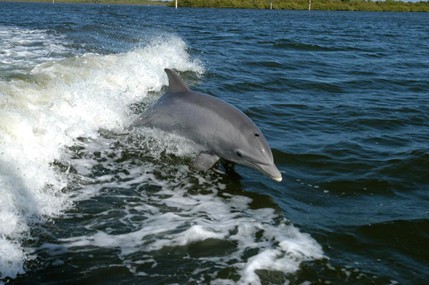 Despite living in the water, dolphins are not fish, they are mammals like us. Just like us, dolphins breath air, give live birth, nurse their babies with milk, and have hair sometime during their life. They are highly intelligent, chatty and playful. There are 36 species of marine dolphins that can be found all over the world, but the one that lives around Hilton Head Island is the Atlantic Bottlenose Dolphin. We have about 200 resident dolphins that live in our waters year-round.
Source – NASA, ID – KSC-04pdO178, Bottlenose Dolphin
Dolphins are carnivores – no veggies for them. They are opportunistic feeders and primarily eat fish, squid, and crustaceans like shrimp and crab. Being opportunistic, they readily adapt their diet to whatever is most available. Dolphins use a technique called echo-location to find their prey and often use cooperative hunting techniques, such as herding fish or trapping them against sandbars.
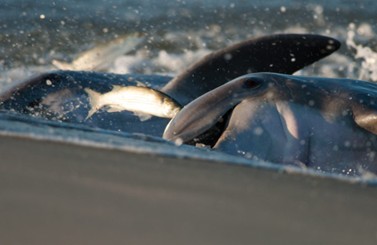
Some of our Hilton Head dolphins have a feeding ritual that is considered extremely rare – Strand feeding. The dolphins line up side-by-side and charge toward the shoreline. Their force creates a wave that herds tiny fish like mullet onto the mudflats or on shore. The dolphins then hoist themselves onto land on their right sides where they gorge themselves on the stranded fish before heading back into the water.
Source: https://www.daufuskieisland.com/strand-feeding-the-dolphin-dining-display/
Dolphin Fun Facts
 Bottlenose dolphins have 72-104 teeth, but they do not chew their food! Instead, they use those teeth to catch their food and then swallow it whole. They also swallow fish headfirst so that the spines don’t catch in their throat. If they lose a tooth, a new one does not grow in its place.
Source: Dolphin Research Center, https://dolphins.org/kids_dolphin_facts
Bottlenose Dolphins sleep with half of their brain at a time, keeping one eye open. Researchers believe they sleep this way to keep an eye out on their group (pod) and to be alert for predators such as sharks.
Bottlenose dolphins, like apes and humans, can recognize themselves in a mirror, which is a sign of high intelligence. They have also been documented using tools. Dolphins in Australia fit marine sponges over their beaks to protect them from sharp rocks as they hunt for fish amongst the rocks.
Dolphins are very chatty animals. They make a variety of sounds, including whistles, clicks, squawks, squeaks, barks, groans, and yelps. Each dolphin has a unique whistle, which they use to identify themselves to others. According to research, dolphins primarily use whistles for long distance communication and by mothers and their calves to find each other if they get separated. They use clicks, which contain ultrasonic information we cannot hear, for orientation and navigation. They use “Burst Pulses,” which are tightly spaced clicks, during close interactions, such as fighting,
And, last but not least, my favorite fact about dolphins – they have amazing hearing! Dolphins have special structures in their jawbones to help them hear sounds. Even their teeth are arranged to function like an antenna to pick up sounds. Dolphins do have ears, like other mammals, but they do not have external ears. Despite the lack of external ears, dolphins have a hearing range that far exceeds that of humans and dogs. Humans can hear a range of sound from 20Hz to 20kHz. Dogs can hear up to 45kHz. But, bottlenose dolphins can hear frequencies as high as 150kHz! In terms of distance, in deeper, open waters, they can hear whistles as far away as 12 miles.
How to See Dolphins in Hilton Head
 Although you can sometimes see dolphins offshore while walking or riding your bike on the beach, the best way to see them is to take one of several Dolphin boat tours.
There are several options for Dolphin tours leaving from Shelter Cove:
Captain Mark’s Dolphin Cruise – https://cruisehiltonhead.com
Outside Hilton Head – https://outsidehiltonhead.com/activity/dolphin-eco-tour/
Salt Marsh Sailing Charters – https://www.sheltercovehiltonhead.com/boat-tours/salt-marsh-sailing-charters
Native Sun Adventures – https://www.sheltercovehiltonhead.com/boat-tours/native-son-adventures
Dolphin Seafari – https://www.sheltercovehiltonhead.com/boat-tours/dolphin-seafari
If you are open to leaving from Broad Creek, I really enjoy the tour offered by the Coastal Discovery Museum. It leaves from the Broad Creek Marina and explores Broad Creek. In addition to Bottlenose Dolphins, you might see river otters, blue crabs, eastern oysters and a variety of birds. It lasts about 90 minutes so it is great if you don’t want to spend all day. It doesn’t go out every day but you can see the schedule and register by going to this link: https://www.coastaldiscovery.org/explore/tours/offsite-excursions/
If you are planning a day in Sea Pines, Vagabond Dolphin Cruises and H2O Dolphin Tours leave from Harbourtown. You can discover more about them at https://www.seapines.com/experiences/watersports#boat-tours